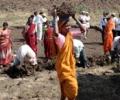
It is true that, at 119 crore person-days, the employment created this year by the Mahatma Gandhi National Rural Employment Guarantee Scheme (MNREGS), the government's flagship programme, is tiny, a fraction of one percentage point of the total employment in the country.
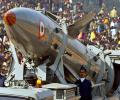
Free provision of food, cash transfers, and jobs in villages see enhanced flow of funds despite a precipitous fall in revenue. Till May, defence spend was nearly 30 per cent less than the previous year.

Launching the scheme, Modi said during the nationwide lockdown, the talent from cities returned to villages and it will now give a boost to development of rural areas. The 'Garib Kalyan Rozgar Abhiyaan' will be implemented on a mission mode in 125 days in 116 districts of six states -- Bihar, Madhya Pradesh, Uttar Pradesh, Rajasthan, Jharkhand and Odisha -- that received the maximum numbers of migrant workers back.

With villagers opposing her return, the tribal girl allegedly gang raped on the order of a kangaroo court in Birbhum district would be provided a job under Mahatma Gandhi National Rural Guarantee Scheme and a house by the state government near her village.

The prime minister also said the government proposes to set up an ombudsman in each district for effective grievance redressal under NREGA.

Amethi member of Parliament Rahul Gandhi's corporate style of electoral management is causing nightmares to those seeking Congress tickets for the forthcoming Assembly elections in Uttar Pradesh.

A total of 22.05 crore applications were received during the period.

The districts have provided 64 days of jobs under the 100-day job scheme as against the state average of 45 days.
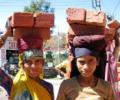
The purpose of the rural job scheme is being defeated as, in this drought year, focus on providing work and timely wages is lost in other things, says economist and activist Jean Dreze.

The government may raise the number of job days under the NREGA scheme to compensate rural households for loss of income due to a poor monsoon in large part of the country.
Both prime ministers believed in crafting schemes to help the common man. Modi used quite effectively the instruments Dr Singh introduced. In assessing Modi's success with many schemes, Dr Singh's fundamental work should not be ignored, points out A K Bhattacharya.

Prime Minister Narendra Modi made a pitch for electing a strong and stable government in an uncertain world beset by geopolitical tensions as the Bharatiya Janata Party on Sunday released its manifesto, prioritising development and welfare while shunning populist measures and contentious issues like the National Register of Citizens (NRC).
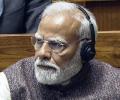
Prime Minister Narendra Modi has lauded the Union Budget as a "people's budget" that fulfills the dreams of every Indian and said that it is a "force-multiplier" that will boost consumption, investment and growth. He highlighted a host of measures for different sectors, including welfare initiatives for gig workers, tax relief for the middle class, and support for the manufacturing sector.
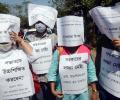
The cumulative loss of salaried jobs since the pandemic is even larger at 12.6 million, reveals Mahesh Vyas.

The Odisha government told the assembly over 40,000 workers migrated from the state last year, with the highest number -- 26,151 -- from Balangir.

Finance Minister Nirmala Sitharaman's Budget proposals lay out a comprehensive road map for transforming India into a developed nation, focusing on key priorities that aim to generate ample opportunities for all citizens in "Viksit Bharat". It sets the stage for sustained economic growth, social development, and technological advancement.
President A P J Abdul Kalam on Monday suggested widening the ambit of Rural Employment Guarantee Scheme (REGS), which primarily caters to manual labour, to include knowledge-based employment.
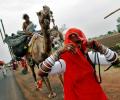
'We cannot leave our entire unorganised sector to the vagaries of market forces.'

An increase in the farmer income support scheme PM Kisan Nidhi, the introduction of a 'robot tax' to fund reskilling of people who lose their jobs to artificial intelligence (AI), and a reduced income-tax (I-T) to bring relief to the middle classes - these are some of the items in the Budget wish list submitted by Sangh Parivar affiliates to Finance Minister (FM) Nirmala Sitharaman. Representatives of the affiliates of the Rashtriya Swayamsevak Sangh (RSS), such as the farmer organisation Bharatiya Kisan Sangh (BKS); trade union Bharatiya Mazdoor Sangh (BMS); Laghu Udyog Bharati, which works for micro and small industries; and Swadeshi Jagran Manch (SJM), which works on economic and policy issues, met the FM and other officials over the last couple of weeks as part of the pre-Budget consultations.

Congress' senior spokesperson Anand Sharma Sharma said Prime Minister Narendra Modi must 'walk the talk' and announce the measures required by giving money in the hands of the poor and small and medium enterprises to help reboot the economy.
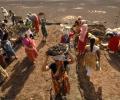
However, ration card, driving licence, voter identity card, Kisan passbook with photo, job card issued under MGNREGS and a certificate issued by a gazetted officer or a tehsildar will be admissible as proof of identity for people to get the benefits under the scheme till the time they get Aadhaar.
Muzaffarpur tops the list with 96,855 double job cards under MNREGA.

'During his stint as prime minister, he got 270 million people out of poverty.' 'This, according to the World Bank, is the fastest compression of poverty anywhere in the world.' Arvind Mayaram, the former finance secretary, recalls his encounters with Dr Manmohan Singh.

Few finance ministers announce any taxation measure that could upset the stock market. Ms Sitharaman decided to take that risk, observes A K Bhattacharya.

'It has been an ongoing process, talking to the relevant ministries about eliminating leakages and curbing non-core expenditure in various schemes.'
The finance minister said the economy had been slowing.
A performance audit on Mahatma Gandhi National Rural Employment Guatantee Act found that Bihar was deprived of grant of Rs 9684.24 crore (Rs 96.84 billion) during 2007-12 in the shape of central share due to less creation of mandays, sharp increase in demand for fund without sufficient justification and unspent balance grant, said the report.

The move is aimed at cutting the fiscal deficit, which the government wants to contain at 4.1 per cent of GDP.
The National Rural Employment Guarantee Act, flagship rural development programme of the United Progressive Alliance government, was launched in February 2006 in 200 districts. It was later expanded to another 130 districts in 2007-08 and eventually extended to cover all the 593 districts.

Market linking of petrol and diesel prices has helped the industry.

'Elections are fought to win.' 'In our party, the leadership takes the final decision, and our leaders are very clear about it.'
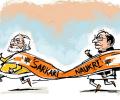
The situation could become more acute as millions of migrants who had returned to their villages during the lockdown come back to the towns for higher wages and better livelihoods.
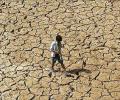
Drought hit Bihar plans to increase the number of days of work from 100 to 150 under the rural job scheme to check migration of the poorest of poor in search of livelihood by providing employment opportunity locally.

The income inequality gap was found to be highest in South Africa and lowest in Denmark.

Around 25 buses carrying Trinamool Congress volunteers set out from Kolkata on Saturday for the planned protest programme in Delhi on October 3 against the alleged withholding of funds by the Centre, party leaders said.
At present, 100 days of work is provided to rural job card holders under the Mahatma Gandhi National Rural Employment Guarantee Act (MGNREGA).
Taking serious note of the rampant corruption in the implementation of the Mahatma Gandhi National Rural Employment Guarantee Act in Uttar Pradesh, the Lucknow bench of Allahabad high court on Friday ordered a Central Bureau of Investogation probe into the alleged large scale financial bungling brought to its notice through a public interest litigation, moved by local journalist Sachchidanand Gupta .
 © 2026 Rediff.com - Advertise with us - Disclaimer - Privacy Policy - Sitemap - Feedback - About us - Terms of use - Grievances